
Marketing Automation: How Businesses Save Time & Increase ROI
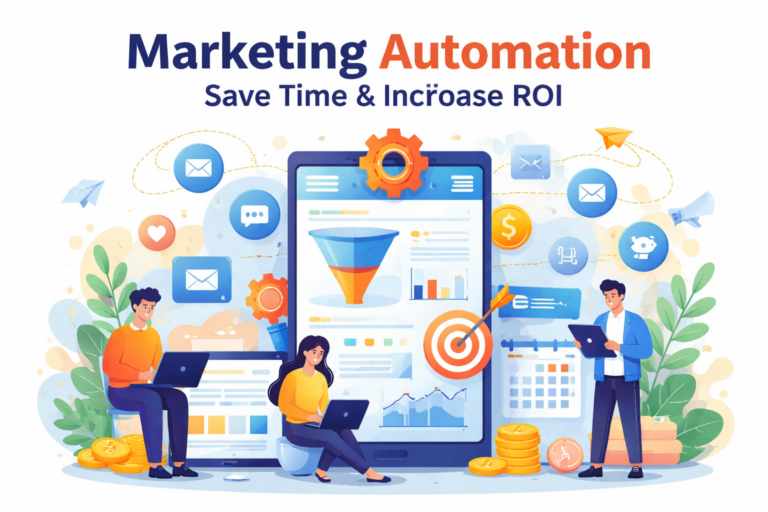
In today’s fast-paced digital world, businesses are under constant pressure to do more with less—less time, fewer resources, and tighter budgets. Customers expect personalized communication, quick responses, and consistent engagement across multiple digital channels. Managing all of this manually is not only time-consuming but also inefficient. This is where marketing automation plays a crucial role. Marketing automation helps businesses streamline repetitive tasks, improve customer engagement, and significantly increase return on investment (ROI).
What Is Marketing Automation?
Marketing automation refers to the use of software and technology to automate repetitive marketing tasks such as email marketing, social media posting, lead generation, lead nurturing, customer segmentation, and campaign tracking. Popular marketing automation tools include HubSpot, Marketo, Mailchimp, ActiveCampaign, Salesforce Marketing Cloud, and Zoho Marketing Automation.
Instead of manually sending emails or following up with leads, businesses can create automated workflows that trigger actions based on user behavior. For example, when a user signs up for a newsletter, downloads an eBook, or abandons a shopping cart, an automated system can instantly send personalized messages without human intervention.
How Marketing Automation Saves Time
One of the biggest advantages of marketing automation is time efficiency. Many marketing activities are repetitive by nature. Automation eliminates the need to perform these tasks manually, allowing marketing teams to focus on strategy and creativity.
- Automated Email Campaigns: Businesses can schedule email campaigns in advance and trigger emails based on customer actions. This reduces manual follow-ups and ensures timely communication.
- Lead Management: Automation tools capture, score, and categorize leads automatically. Sales teams receive only qualified leads, saving time spent on unproductive prospects.
- Social Media Scheduling: Marketing automation allows businesses to plan and publish content across multiple platforms from a single dashboard.
- Customer Journeys: Pre-built workflows guide customers through the buying process automatically, reducing the need for constant monitoring.
By automating these processes, businesses reduce workload, minimize errors, and maintain consistency across campaigns.
Marketing Automation for Small and Large Businesses
Marketing automation is not limited to large corporations. Small and medium-sized businesses (SMEs) also benefit greatly from automation tools. For small businesses with limited resources, automation acts as a virtual marketing assistant—handling tasks that would otherwise require a dedicated team.
Large enterprises, on the other hand, use automation to manage complex customer journeys, integrate multiple channels, and maintain consistency at scale. Whether it is a startup or a multinational company, marketing automation adapts to business size and goals.
Challenges and Best Practices
While marketing automation offers many benefits, it must be implemented correctly. Over-automation can make communication feel robotic and impersonal. Businesses should focus on balancing automation with human creativity.
Best practices include:
- Clearly defining marketing goals before automation
- Segmenting audiences properly
- Creating high-quality, valuable content
- Regularly analyzing performance data
- Continuously optimizing workflows
Automation should support marketing strategy, not replace it entirely.
Conclusion
Marketing automation has become an essential tool in modern digital marketing. By automating repetitive tasks, businesses save valuable time, reduce costs, and improve efficiency. More importantly, automation enables personalized, data-driven marketing that enhances customer experience and boosts ROI. In an increasingly competitive digital landscape, businesses that embrace marketing automation gain a significant advantage over those that rely on manual processes. When used strategically, marketing automation is not just a time-saving solution—it is a powerful driver of sustainable business growth